
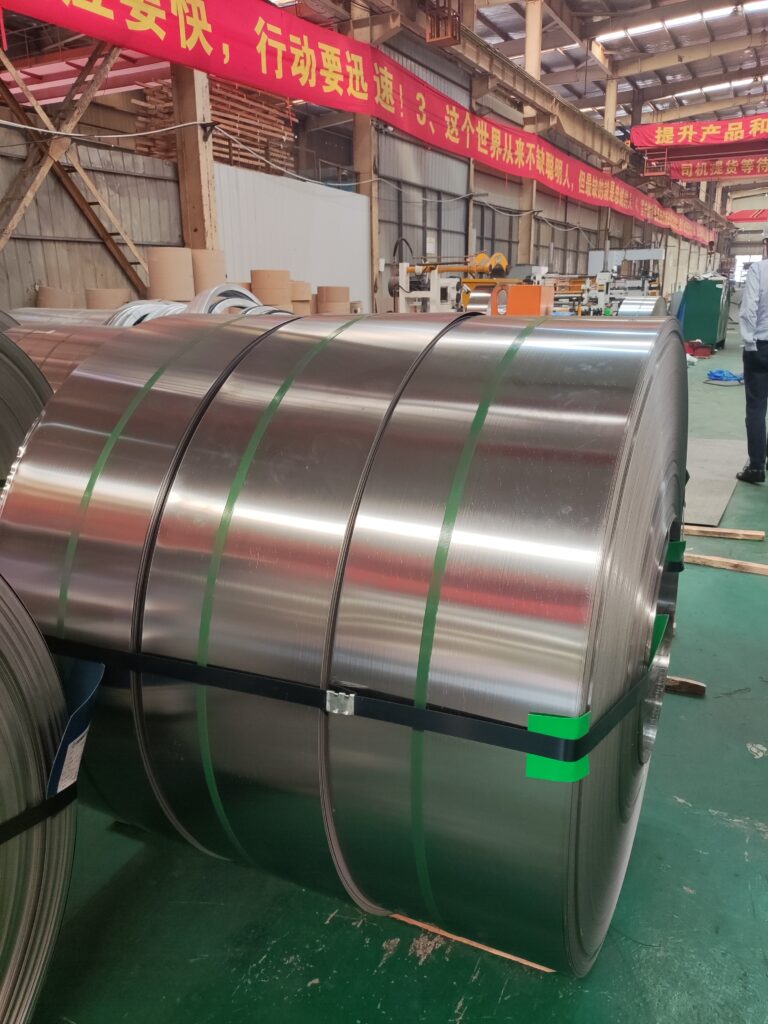


SUS420J1 has a certain wear resistance and corrosion resistance, high hardness, its price is the lower class of stainless steel ball, suitable for the ordinary requirements of stainless steel working environment.
420J2 stainless steel belt is a grade of stainless steel produced according to the American ASTM standard; Japanese standard SUS420J2, new national standard 30Cr13, old national standard 3Cr13, digital code S42030, European standard 1.4028.
420J1 stainless steel: high hardness after quenching, good corrosion resistance (magnetic) 420J2 stainless steel after quenching, higher hardness than 420J1 steel (magnetic).
Generally, the quenching temperature of 420J1 is 980~1050℃, and the hardness of 980℃ heating oil quenching is significantly lower than that of 1050℃ heating oil quenching, the hardness of 980℃ oil quenching is HRC45~50, and the hardness of 1050℃ oil quenching is 2HRC higher. However, the microstructure obtained after quenching at 1050℃ is coarser and brittle. It is recommended to use 1000℃ heating quenching to obtain better microstructure and hardness. The hardness of 420 series steel after heat treatment is roughly HRC52~55, and the performance of damage resistance and other aspects is not too outstanding. Because it is easier to cut and grind, it is suitable for the production of tools, 420 stainless steel is also known as “cutting tool grade” martensitic steel. 420 series steel due to low carbon content (carbon content: 0.16~0.25) and excellent rust resistance, it is the ideal steel for the production of diving tools.